
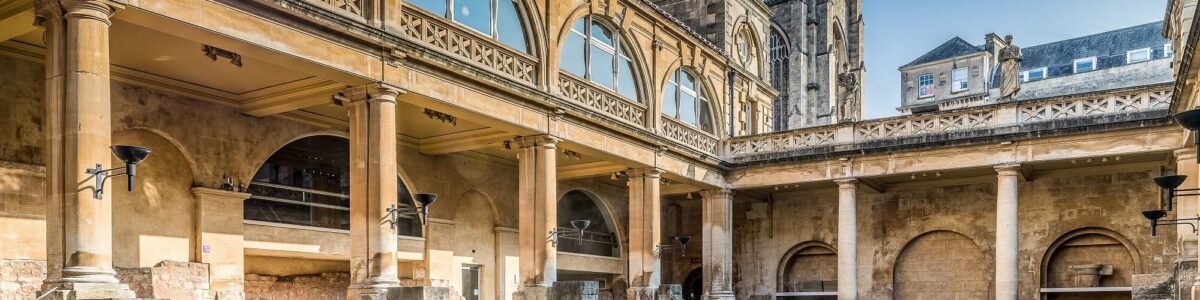
As well as being a city with a vibrant cultural offering, Bath is a living museum. With a double-UNESCO World Heritage inscription, this city has rich layers of history and heritage embedded through its streets and beyond. Nestled in the rolling hills of Southwest England, Bath has been attracting visitors for thousands of years – from the Romans who visited its healing springs, to the Georgians who flocked to the city for high society. Today, visitors enjoy the unique offering of history and modern culture.
Bath was first inscribed as a UNESCO World Heritage Site in 1987 for its remarkable Roman remains and harmonious Georgian architecture. In 2021, it became part of The Great Spa Towns of Europe, a serial transnational UNESCO World Heritage Site formed of a group of Europe’s finest spa towns.
Archaeological evidence suggests that there was human activity around the hot springs on which Bath is built as far back as 8000 BC. Much later, in 863 BC, according to legend, Prince Bladud founded the city of Bath around the hot springs.
The Roman Baths are one of the city’s oldest and most famous historic attractions. Built around natural hot springs nearly 2,000 years ago, this remarkably preserved site allows you to walk in the footsteps of ancient Romans. Walk by ancient pools of mineral water, saunas, plunge pools and more to see how our ancestors used Bath’s natural resources for wellness. An extensive museum is created among the ruins, displaying a treasure trove of archaeological finds – even from before the Romans. The ruins have also been augmented by reconstructions and interactive displays illustrating how Bath’s natural hot springs were used in the past, offering an immersive insight.
Thousands of years later, the Georgians saw Bath as a place to socialise, promenade and take the waters. While the Romans would have bathed in the mineral-rich water, it was the Georgians who began drinking it in the late 17th century. They came to Bath to take the waters, which you can still do today.
Bath is still renowned for its Georgian architecture, which keeps the city looking as it did many centuries ago. This is why Bath is a popular filming location for series like Bridgerton and Agatha Christie’s Seven Dials. Visitors can simply wander the streets to immerse themselves in Georgian history or get a more insightful experience at a museum.
The Royal Crescent is an architectural icon and a world-renowned representation of Georgian architecture. Step inside to No. 1 Royal Crescent which preserves a Georgian house exactly as it was. Each room is designed to show you how the Georgians would have furnished their houses, with guides to tell stories of the past.
The Pump Room is where high society flocked and it became the heart of the Georgian social scene. The waters are pumped from the ornate King’s spring water fountain, overlooking the Roman Baths. Today, visitors can still take a sip of the water and experience its unique, mineral-rich taste!
Take another step back in time at the Herschel Museum of Astronomy. The former home of astronomer and musician William Herschel and his sister Caroline, the house is now dedicated to their achievements in music and astronomy. In 1781, Herschel discovered the planet Uranus from his back garden, with a telescope of his own construction. Occasional astronomy sessions take place outside the Herschels’ workshop in the charming eighteenth-century formal garden.
Experiencing Bath’s heritage doesn’t just mean visiting museums and ancient ruins. This social city has plenty of ‘living traditions’, housed in beautiful, historic buildings. Theatre Royal Bath is one of the oldest and most historic theatres in the country where the Main House hosts a varied programme of top-quality drama, opera, comedy, dance and musicals. Set in a Grade I listed building, The Holburne Museum holds a collection of fine and decorative art, while The American Museum is in a Grade I listed Georgian estate with a majestic prairie-style garden.
Cities have always been centres for live entertainment and contemporary culture, and Bath still has plenty of vibrancy and energy. Music fans, comedy lovers and theatre-goers have plenty to choose from. Traditional British pubs are full of warm hospitality and some run midweek entertainment such as quizzes and live music, with gigs almost every night at The Bell Inn, or Irish folk sessions at The Grapes.
Once you’ve explored World Heritage Bath, you can continue your cultural journey with a trip to one of the two additional World Heritage Sites within easy reach of the city. Just under an hour’s drive from Bath, Stonehenge is a remarkable monument which was erected between 3,000 BC and 1,600 BC, and you’ll find the Avebury Stone Circle, the largest stone circle in Europe, 27 miles from Bath.